The New Retirement Threat: How the Iran War Could Hit Your CPP, OAS and Investments
April 21/2026
Something you probably didn’t have on your 2026 retirement planning checklist: a war in the Middle East reshaping global energy markets, rattling stock markets, and complicating the Bank of Canada’s next move on interest rates. Yet here we are.
Since U.S. and Israeli forces launched strikes on Iran at the end of February, the global economy has been absorbing a significant energy shock. For Canadian retirees — people who depend on CPP, OAS, and their own savings to fund their daily lives — the ripple effects deserve a close look.
The Oil Price Shock: Why It Matters for Retirees
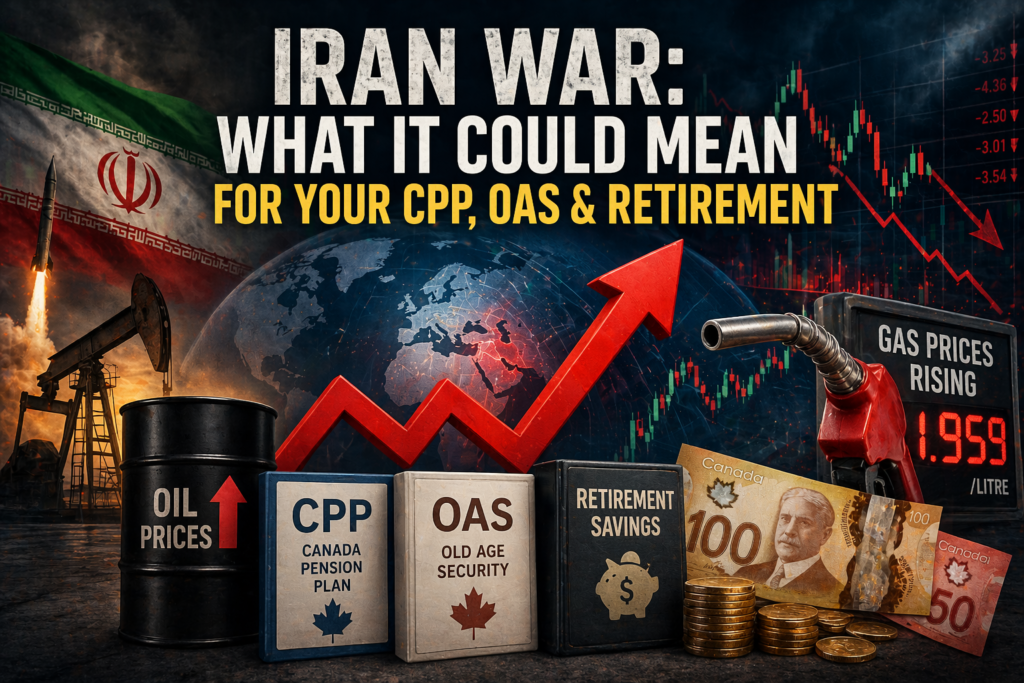
The Strait of Hormuz — the narrow channel through which roughly 20 percent of the world’s oil and natural gas travels — has been severely disrupted since the conflict began. The result has been swift and dramatic. Brent crude oil prices surged more than 25 percent from pre-war levels, briefly touching US$120 a barrel before easing somewhat.
For Canadian retirees on fixed incomes, higher oil prices translate directly into higher costs at the gas pump and, eventually, at the grocery store. The Bank of Canada has already flagged that energy is a major input cost for food, meaning that if the conflict drags on, grocery bills could follow gas prices upward — squeezing retirees who are already navigating elevated food inflation.
| What Does This Mean for CPP and OAS? CPP and OAS are both indexed to inflation — but they adjust after the fact, not in real time. CPP adjusts annually each January using the 12-month Consumer Price Index average. OAS adjusts quarterly. If inflation rises significantly in 2026 due to the energy shock, both benefits will eventually catch up — but there is a lag, which means purchasing power can erode in the interim. |
The Bank of Canada Is Stuck in a Difficult Spot
The Bank of Canada held its benchmark rate at 2.25 percent in March, but Governor Tiff Macklem was frank about the challenge. Raising rates to fight energy-driven inflation risks weakening an already sluggish economy. Cutting rates to support growth risks letting inflation run hotter. As Macklem put it, this is a genuine dilemma.
Most economists now expect the Bank of Canada to hold its rate steady for the remainder of 2026. That matters for retirees in a few ways: GIC and savings rates stay roughly where they are, and variable-rate income products won’t see further cuts. If the war escalates and inflation proves persistent, a rate hike — something that seemed unthinkable earlier this year — cannot be fully ruled out.
| Scenario | Oil Price Range | Likely BoC Response |
| Short conflict (weeks) | US$65–80/barrel | Hold, possible cut late 2026 |
| Medium conflict (months) | US$100–130/barrel | Hold through 2026 |
| Prolonged conflict | US$130–150+/barrel | Hold or possible rate hike |
What About Your Investment Portfolio?
The TSX has not been immune. Stock markets sank in the weeks following the initial strikes, with the S&P/TSX Composite falling significantly as higher energy prices and inflation fears drove risk-off sentiment. However, the picture is more nuanced for Canadian investors than for many global markets.
Energy stocks make up roughly 17 percent of the TSX, which means Canadian Natural Resources, Suncor, and similar names actually benefit from higher crude prices. On the day the broader TSX fell sharply in mid-March, several major Canadian energy producers rose. For retirees with diversified Canadian equity exposure, some of the pain may be partially offset.
The more significant concern for retirees is bonds. Higher inflation fears tend to push bond yields up, which means the value of existing bonds declines. A portfolio that relied on long-duration bonds for protection may not provide the cushion that was expected during this kind of shock.
Is Cash a Good Idea Right Now?
Given the uncertainty, some retirees are wondering whether moving to cash — or cash-equivalent products — makes sense. The honest answer is: it depends on what you need the money for and when.
Short-term cash needs are well-served by high-interest savings accounts, GICs maturing within 12 months, or Government of Canada Treasury bills. With the Bank of Canada rate holding at 2.25 percent, deposit rates remain reasonable. Parking money you need within the next one to two years in something stable and liquid is a defensible strategy during periods of geopolitical uncertainty.
The risk of going too heavily to cash, however, is that if the conflict de-escalates — and markets stage a sharp recovery — you may miss the rebound. The TSX jumped 833 points in a single session on March 31 when ceasefire optimism briefly swept through markets. Investors who moved to the sidelines in a panic may find themselves on the wrong side of that kind of move.
For retirees drawing down from a RRIF, holding enough in cash or short-term GICs to cover one to two years of withdrawals is generally considered sound planning — not because of this specific conflict, but as a standing buffer against sequence of returns risk. That buffer means you don’t have to sell equities at depressed prices to fund living expenses.
| A Note on Sequence of Returns Risk For retirees taking regular RRIF withdrawals, a prolonged market downturn combined with higher inflation is one of the most challenging scenarios to navigate. Selling assets to fund withdrawals when markets are down can permanently erode portfolio value. A short-term cash buffer — covering roughly one to two years of planned withdrawals — can help insulate against this without abandoning long-term growth. Click on article for info on RRIF withdrawals |
The Bigger Picture for Canadian Retirees
Canada is somewhat better positioned than many other countries. We are a net exporter of both energy and fertilizer, meaning higher global commodity prices actually support parts of the Canadian economy. The federal government suspended fuel taxes as a short-term measure to ease the pinch at the pumps.
CPP and OAS will continue to be paid on schedule. They will adjust upward over time if inflation proves persistent. Neither is at risk due to global geopolitical events — the CPP Investment Board’s globally diversified portfolio is designed to withstand market volatility over decades, not react to individual crises.
Still, what this conflict reinforces is something Canadian retirees already know: fixed-income sources like CPP and OAS provide a foundation, but inflation can erode real purchasing power in the gap between what the index measures and what you actually spend money on. Energy and food tend to hit retirees harder than younger Canadians, since a greater share of their budget goes toward necessities.
The situation in the Middle East remains fluid. What matters for your retirement plan is not predicting the outcome of the war, but ensuring your plan is resilient enough to handle the uncertainty — whether that means reviewing your RRIF withdrawal strategy, reassessing your bond exposure, or simply making sure your short-term cash needs are covered.
As always thanks for reading ,
Greg
For informational purposes only. This is not financial advice.
© 2026 canadaretirementincome.ca | For informational purposes only. Not financial advice.