April 26/2026
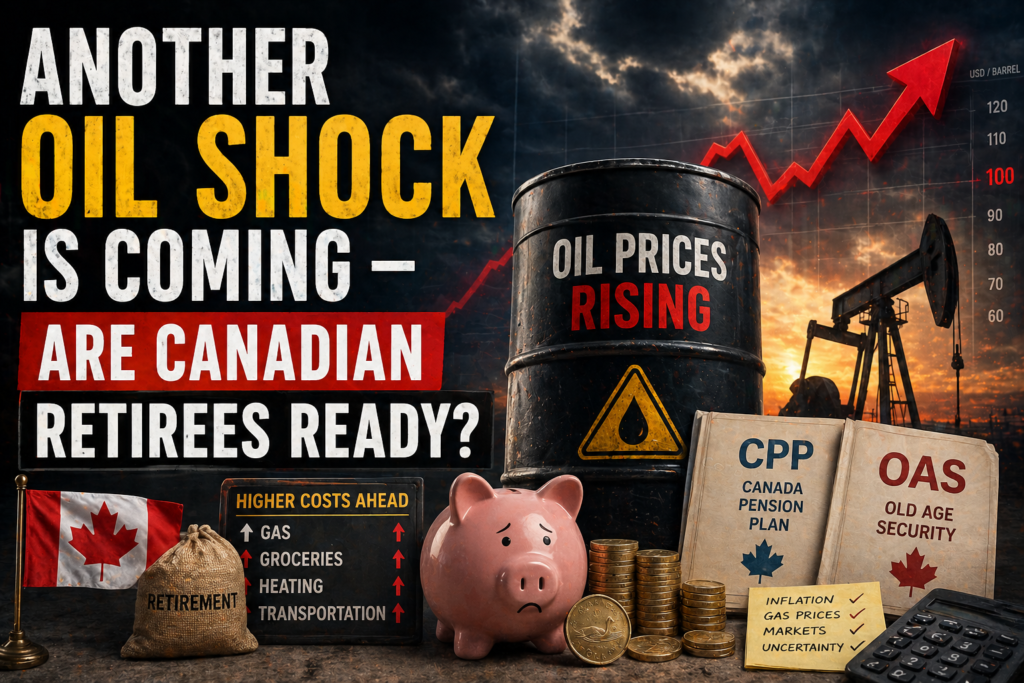
Oil markets have never been calm for long. From the Arab embargo of the 1970s to the COVID price collapse of 2020 — and the sharp rebound that followed — crude oil has a history of shocking economies at the worst possible moments. And right now, the conditions for another major swing are quietly building.
For Canadian retirees and those approaching retirement, an oil shock isn’t just a headline — it’s a financial event that can ripple through your CPP payments, your RRIF portfolio, and the cost of filling your grocery cart. Here’s what you need to know, and what you can do about it.
Why Oil Matters More to Canadian Retirees Than You Might Think
Canada is one of the world’s top oil producers. That means the health of the energy sector has an outsized effect on the broader economy — including government revenues and public pension sustainability.
The Canada Pension Plan Investment Board (CPPIB) manages over $600 billion in assets on behalf of current and future CPP recipients. A significant portion of that portfolio is exposed to energy sector equities, infrastructure, and natural resource investments. When oil prices swing sharply, so does the value of those holdings.
Beyond the CPP, oil price volatility affects Canadian retirees through:
• Inflation — rising oil pushes up transportation, heating, and food costs, eroding purchasing power
• Interest rates — the Bank of Canada may raise rates to fight oil-driven inflation, pressuring bond and GIC values
• Equity markets — Canadian stock indices are heavily weighted toward energy, meaning RRIF portfolios often move with oil
• OAS clawback thresholds — inflation erodes the real value of the clawback floor, catching more retirees
What Kind of Oil Shock Could Be Next?
Analysts are currently watching several scenarios that could trigger significant oil price movement. The table below summarizes the four most discussed possibilities and their likely impact on Canadian retirees.
| Scenario | Oil Price Range | Impact on CPP/OAS | Retiree Risk Level |
| Supply Surge (OPEC+) | US$40–55/bbl | Modest — energy revenues dip | Low–Moderate |
| Geopolitical Disruption | US$100–120/bbl | Inflation spike, BoC rate risk | Moderate–High |
| Prolonged Price Collapse | Below US$40/bbl | Alberta GDP drag, equity sell-off | High |
| Demand Destruction (EV shift) | Structural decline | Long-run CPPIB rebalancing | Long-term watch |
Note: Oil prices in USD per barrel (bbl). CPP/OAS impacts are indirect and long-term in nature. This table is for educational purposes only.
CPP Is Designed to Absorb Shocks — But It’s Not Immune
The CPP is one of Canada’s most resilient financial institutions. Its long investment horizon, global diversification, and actuarial funding model give it a buffer that most individual investors don’t have. Even during the 2008–09 financial crisis, the CPP fund recovered and continued full benefit payments.
That said, a prolonged energy bear market — particularly one driven by structural demand destruction as electric vehicles and clean energy displace fossil fuels — would eventually require the CPPIB to rebalance away from Canadian energy assets. That transition takes years, not months.
| What This Means for Your CPP Payments Your CPP benefit amount is determined at the time you start receiving it and is indexed annually to CPI. It is not directly reduced by oil prices or CPPIB performance. However, if the CPP fund were ever to face solvency concerns — an unlikely but not impossible scenario in a decades-long structural shift — contribution rates or future benefit formulas could be adjusted. Current projections show the CPP is fully funded for at least 75 years. |
The Bigger Risk: Sequence of Returns During an Oil Spike
For retirees drawing down an RRIF, the most immediate oil-related danger isn’t a collapse in CPP — it’s what a sudden oil-driven market correction does to your portfolio at the wrong time. See related articles on RRIF here.
Here’s the classic problem: if oil prices spike sharply (say, due to a Middle East supply disruption), Canadian equity markets may initially rally — good for energy stocks — but then face a broader correction as inflation rises and the Bank of Canada responds with rate hikes. Bond prices fall. Growth stocks fall. And your RRIF is being drawn down at exactly the wrong moment.
This is sequence of returns risk made worse by commodity volatility. A 20% portfolio drop in year two of retirement is significantly more damaging than the same drop in year fifteen, because you’ve already withdrawn funds at the lower balance.
| Key Risk Reminder Sequence of returns risk means the order of your investment gains and losses matters as much as the average return. A sharp oil-driven market correction in the early years of your RRIF drawdown phase can permanently reduce your long-term income, even if markets eventually recover. |
How Retirees Can Reduce Oil-Related Financial Risk
You can’t predict oil prices — nobody can. But you can structure your retirement finances to be more resilient to the shocks that inevitably come.
Consider the following strategies:
• GIC Laddering: Holding a portion of your RRIF or TFSA in a GIC ladder (e.g., 1-year, 2-year, 3-year, 4-year, 5-year) provides predictable income that isn’t affected by equity market swings driven by oil volatility.
• Geographic Diversification: Canadian equity indices are heavily concentrated in energy and financials. Holding global ETFs reduces your exposure to domestic oil sector swings.
• Cash Buffer Strategy: Maintaining 12–24 months of expenses in a high-interest savings account (HISA) or cash equivalent gives you flexibility to avoid selling equities during a downturn.
• Delay CPP If Possible: Since CPP grows by 0.7% per month for each month you delay past 65 (up to age 70), waiting until markets are stable to begin drawdown of other assets may allow CPP’s guaranteed base to carry more weight.
• Annuity Consideration: A portion of savings converted to a life annuity removes market risk entirely for that tranche of income — though it sacrifices flexibility.
OAS and GIS: More Insulated, But Not Inflation-Proof
Old Age Security (OAS) and the Guaranteed Income Supplement (GIS) are funded through general government revenues rather than an investment fund, so they are not directly exposed to oil-driven market risk. OAS is also indexed quarterly to CPI, which provides some inflation protection if oil pushes prices higher.
However, the OAS clawback (officially called the “OAS Recovery Tax”) begins when net income exceeds approximately $90,997 (2024 threshold). For retirees with significant RRIF income, an inflationary spike that slightly increases their income — even from indexed sources — could push them above the clawback threshold. This is a less visible oil-related risk worth monitoring. Use our OAS clawback calculator for estimates on OAS
The Bottom Line
Oil shocks are not rare events — they are recurring features of a global economy still deeply dependent on fossil fuels. For Canadian retirees, the risks are real but manageable. The CPP is built to withstand market disruption. OAS provides a relatively stable floor. But your personal portfolio, particularly within a RRIF in the drawdown phase, can be meaningfully affected by the right kind of oil-driven market event at the wrong time.
The best response is not to predict the next shock — it’s to build a retirement income structure that doesn’t depend on oil staying calm. That means diversification, a cash buffer, and a clear drawdown strategy.
If you’re not sure your current plan accounts for commodity volatility, this is a good time to revisit it.
This article is for informational and educational purposes only. It does not constitute financial, investment, or tax advice. Please consult a qualified financial advisor before making any retirement planning decisions.
As always thanks for reading ,
Greg