
Everything you need to know about RRIFs, minimum withdrawals, and whether converting early actually makes sense for you.
By Greg
Let’s be honest — most of us spend decades thinking about building our RRSP. We contribute every year (or try to), watch the balance grow, and pat ourselves on the back for being responsible. But somewhere around your late 50s or early 60s, a slightly uncomfortable question starts to surface:
What exactly happens to all this money when I retire?
If you’ve been wondering about RRIFs — what they are, when you need one, and how much the government is going to want from you each year — you’re in the right place. Let’s break it all down in plain language, because this stuff matters more than most people realize.
First Things First: What Is a RRIF?
A RRIF (Registered Retirement Income Fund) is essentially the next chapter of your RRSP story. When your RRSP reaches its deadline — December 31st of the year you turn 71 — it must be converted. You can’t just leave it sitting there indefinitely. The CRA wants to start seeing those tax-deferred dollars come out and, yes, get taxed.
A RRIF works similarly to an RRSP in terms of how your investments are held, but instead of putting money in, you’re now taking money out — at least a minimum amount each year.
Think of it like this: your RRSP was the accumulation phase. Your RRIF is the distribution phase. Same account, different direction.
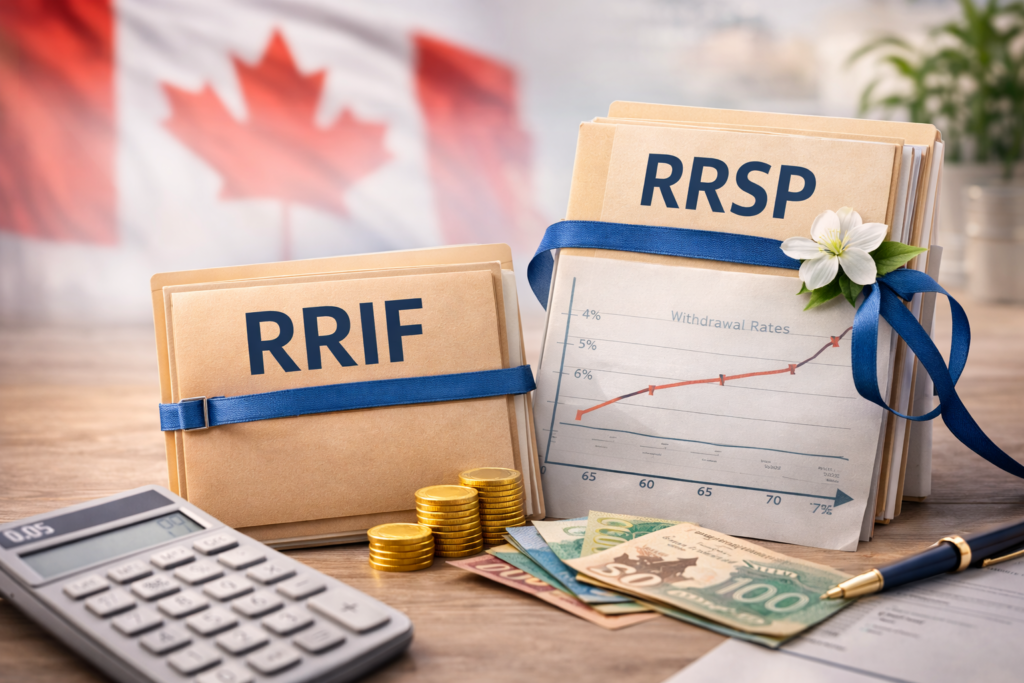
RRIF Minimum Withdrawal Rates Explained
Here’s where it gets a bit technical, but stick with us — it’s worth understanding.
Every year after you open a RRIF, you must withdraw a minimum percentage of the account’s value. The percentage is set by the federal government and increases as you age. The logic? The older you get, the more of your savings you’re expected to draw down.
Here’s a simplified snapshot of how those rates look:
• Age 71: approximately 5.28%
• Age 75: approximately 5.82%
• Age 80: approximately 6.82%
• Age 85: approximately 8.51%
• Age 90+: rates climb toward 20% and beyond
So if you have $500,000 in your RRIF at age 71, you’d need to withdraw at least $26,400 that year. At 85 with the same balance, that number would be over $42,500.
These withdrawals are added to your income for the year and taxed accordingly. If you’ve got other income sources — CPP, OAS, a pension — those RRIF withdrawals can push you into a higher tax bracket faster than you might expect. That’s why planning ahead is so important.
Pro tip: If your spouse is younger than you, you can use their age to calculate your minimum withdrawal — which means lower minimums and more time for your money to keep growing.
Should You Convert Your RRSP to a RRIF Early?
Now here’s a question that genuinely surprises a lot of people: you don’t have to wait until you’re 71 to convert your RRSP to a RRIF. You can do it any time.
So should you? Maybe. It really depends on your situation.
When Early Conversion Could Make Sense
You’ve already retired and you need income. If you’ve stepped away from work in your early 60s and need to draw on your savings, a RRIF lets you do that in a structured way. And unlike the RRSP, there’s no penalty for withdrawing — it’s literally designed for withdrawals.
Your income is lower right now. Here’s something counterintuitive: the years between retirement and when CPP, OAS, and other income kick in can actually be a tax planning sweet spot. If your income is relatively low in those years, strategically drawing down your RRSP (by converting to a RRIF) at a lower tax rate could save you significant money down the road.
You want to avoid a big RRIF balance at 71. The larger your RRIF when minimum withdrawals kick in, the bigger those mandatory withdrawals will be — and the bigger your tax bill. Shrinking that balance earlier, when you have more control over how much you take, can be a smart move.
When Waiting Makes More Sense
You’re still working and earning income. Adding RRIF withdrawals on top of employment income is usually a bad idea. You’d be pulling taxed money out at a higher rate than necessary.
You have other income sources to cover your needs. If a pension, investment income, or savings outside your RRSP are covering your retirement expenses, there’s likely no urgency to tap into your RRSP early.
You want to maximize tax-sheltered growth. Every year your money stays in an RRSP or RRIF, it continues to grow tax-deferred. Sometimes the best move is simply to let it keep compounding.
The Big Picture: It’s About More Than Just the Numbers
We know — this stuff can feel overwhelming. But here’s the thing: understanding how RRIFs and withdrawal rates work puts you in a much stronger position to make smart decisions. Whether that means converting early to take advantage of a low-income window, or waiting until 71 and optimizing from there, the key is being intentional about it rather than letting the government’s timeline decide for you.
Retirement income planning isn’t a one-size-fits-all exercise. Your tax situation, your spouse’s income, your other assets, your health, your lifestyle goals — they all play a role. That’s why working through this with a financial advisor who knows your full picture can make a real difference.
The goal isn’t just to have money in retirement. It’s to keep as much of it as possible working for you, for as long as possible.
If you’re in your 50s or 60s and starting to think seriously about the transition from saving to spending, now is the right time to get a plan in place. The decisions you make in the next few years can have a significant impact on how much income you have — and how much tax you pay — for the rest of your life.
Have questions about your RRSP, RRIF, or retirement income strategy? We’d love to help you think it through. Reach out anytime — no jargon, no pressure, just a real conversation about your future.
As always thanks for reading ,
Greg
Planning your retirement income involves many moving pieces.
Browse our other articles on CPP benefits, OAS rules, RRSP strategies, RRIF withdrawals, and retirement planning in Canada.
© 2026 www.canadaretirementincome.ca ·Retirement Income Strategies for Canadians For informational purposes only · Not financial advice