Which Accounts Should You Empty First in Retirement? Financial Blog
$$$
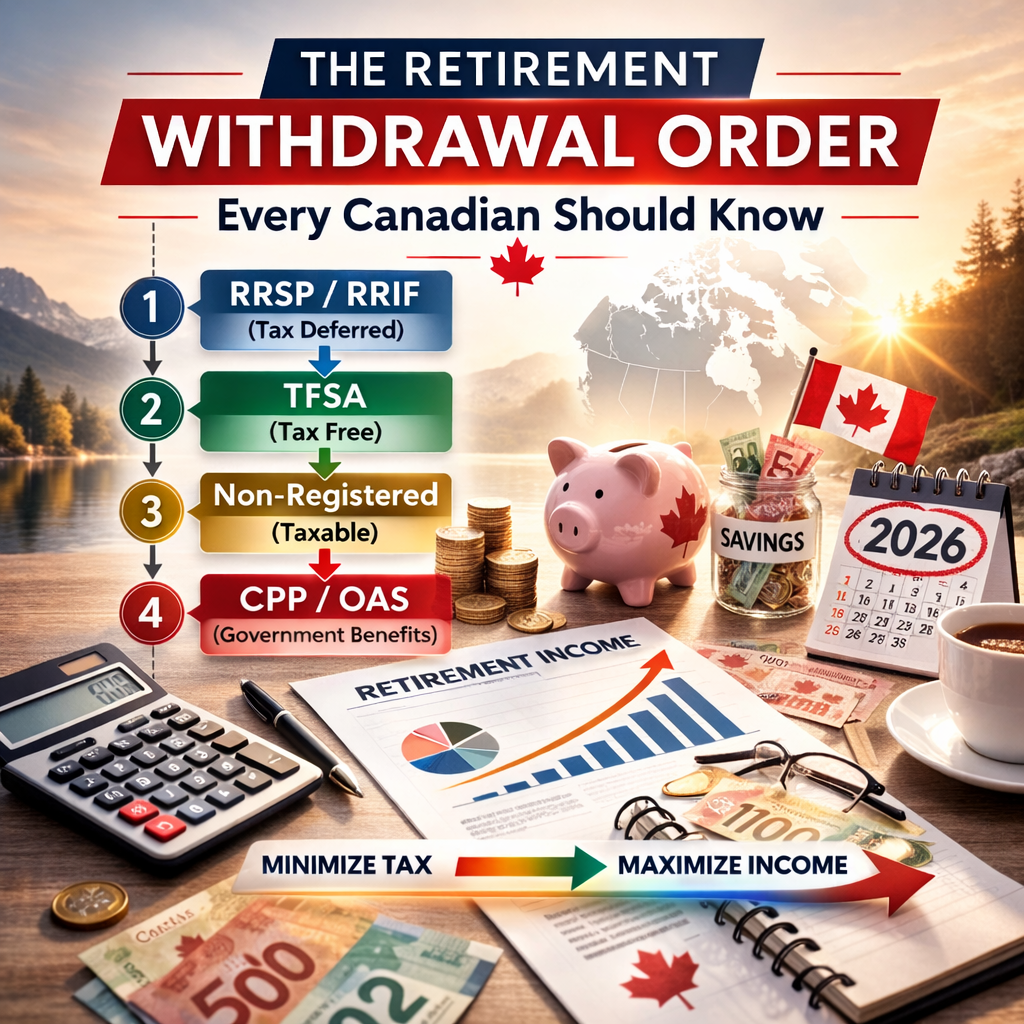
The Retirement Withdrawal Order
Every Canadian Should Know
Most Canadians spend decades filling up their accounts — but very few have a plan for drawing them down. The order you withdraw from matters more than most people realize.
By Greg · February 2026 · 9 min read
You’ve spent your working years dutifully contributing to your RRSP, building up your TFSA, maybe even socking away money in a non-registered investment account. Now retirement is here — or nearly here — and a question nobody warned you about has arrived: which account do you pull from first?
It might feel like a minor administrative detail, but the order in which you draw down your accounts can mean tens of thousands of dollars in extra taxes over the course of your retirement — or the difference between keeping your full OAS pension and losing part of it every year. Getting the sequence right is one of the highest-leverage moves in retirement planning.
Understanding What You’re Working With
Before diving into strategy, it helps to understand how each account type is taxed — because each one treats withdrawals very differently.
| Account | Withdrawals Taxed? | Affects OAS/GIS? | Growth Inside |
|---|---|---|---|
| Non-Registered | Capital gains & dividends taxed annually | Yes | Taxable each year |
| RRSP / RRIF | Yes — 100% as income | Yes | Tax-deferred |
| TFSA | Never | No | Completely tax-free |
| FHSA | Only if not used for home purchase | Yes (if taxable) | Tax-free while open |
| DB Pension / CPP / OAS | Yes — 100% as income | Yes | N/A |
The core insight is this: not all dollars are equal in retirement. A dollar in your TFSA is worth more than a dollar in your RRSP, because you’ve already paid tax on it and will never pay tax on it again. A dollar in your non-registered account sits somewhere in between, depending on how much of it is unrealized gains.
“The order you withdraw from your accounts can be worth more than the returns you earn inside them — yet most Canadians never plan for it.”
The General Draw-Down Framework
There’s no single perfect sequence for everyone — but there is a general framework that works well for most Canadians who don’t have a large defined benefit pension dominating their income picture.
1
First to draw down
Non-Registered Accounts
Withdrawing from non-registered accounts first eliminates ongoing annual tax drag on dividends and interest. If your holdings have appreciated significantly, you can spread capital gains realizations across multiple early retirement years — potentially keeping yourself in a lower bracket. Once emptied, the tax friction disappears entirely.
2
Second — but strategically
RRSP / RRIF Withdrawals
Rather than letting your RRSP sit untouched until mandatory RRIF minimums kick in at 71, consider drawing it down gradually through your 60s while your income is still relatively low. This “RRSP meltdown” strategy smooths out your taxable income over many years — keeping you in lower brackets and reducing the forced withdrawal cliff at 71.
3
Last — protect it as long as possible
TFSA
Your TFSA is your most valuable account in retirement — keep it growing tax-free for as long as possible. When you do draw from it, every dollar arrives completely tax-free and doesn’t count toward OAS clawback thresholds, GIS eligibility, or any income-tested benefit. Think of the TFSA as your emergency reserve and your OAS shield.
The RRIF Problem: Why You Can’t Just Wait
Here’s where many Canadians get caught off guard. At age 71, your RRSP must convert to a Registered Retirement Income Fund (RRIF). Once it does, you’re required to withdraw a minimum percentage of the fund’s value each year — whether you need the money or not.
These mandatory minimums start at roughly 5.28% of the fund value at age 71 and climb every year. For someone with a $600,000 RRIF, that’s over $31,000 in forced taxable income per year — on top of CPP, OAS, and any other income. For many retirees, this pushes them over the OAS clawback threshold of $95,323 and starts eroding their OAS benefit at 15 cents per dollar.
The solution? Begin drawing down your RRSP — strategically — in the years before 71. If you retire at 62 and have low income for a few years before CPP and OAS kick in, those years are a golden window to make RRSP withdrawals at a low tax rate and redirect the after-tax proceeds into your TFSA.
Where the FHSA Fits In
The First Home Savings Account is primarily designed for first-time homebuyers, but some near-retirees may hold one if they haven’t yet purchased a home. If you have an FHSA and won’t be using it for a home purchase, you have until age 71 to either transfer the balance to an RRSP (without using your contribution room — a nice bonus) or convert it to a RRIF. Used this way, the FHSA essentially becomes an extra RRSP contribution, making it worth holding onto strategically rather than drawing from early.
Two Retirement Scenarios
Linda, 63 — No Pension
RRSP-First Approach
Linda retires at 63 with $450K in her RRSP, $90K in her TFSA, and $80K in non-registered investments. CPP and OAS won’t start until 65 and 65 respectively. She draws down her non-registered account first, then begins modest RRSP withdrawals at $40K/year to stay in a low bracket — redirecting the after-tax amount into her TFSA. By 71, her RRIF is much smaller and her TFSA is a powerful tax-free reserve.
Robert, 65 — DB Pension
TFSA-Shield Approach
Robert’s defined benefit pension pays $70,000/year. Add CPP and OAS and he’s already above $90,000 in taxable income — dangerously close to the OAS clawback. He avoids drawing from his RRIF until mandatory minimums force him to, and draws exclusively from his TFSA for any top-up spending. His TFSA withdrawals don’t count as income, preserving his full OAS benefit.
Key Strategies to Maximize Every Dollar
- Pension income splitting: If you have a RRIF, eligible pension income, or a defined benefit pension, you and your spouse can split up to 50% of that income on your tax returns — potentially saving thousands per year by keeping both spouses in lower brackets.
- Delay CPP if you can: Every year you delay CPP past 65 increases your benefit by 8.4%. If you can draw from your RRSP or non-registered account in the early retirement years, delaying CPP to 70 boosts your guaranteed lifetime income significantly.
- RRSP-to-TFSA pipeline: In years when your income is low, withdraw from your RRSP and immediately contribute the after-tax amount into your TFSA. You’re converting taxable savings into tax-free ones — a move that pays dividends for decades.
- Watch the OAS threshold: In 2026, OAS begins to claw back at $95,323 in net income. Model your income each year to stay under this line where possible — especially in years when RRIF minimums are large.
- Spousal RRSP withdrawals: If your spouse is in a lower tax bracket, withdrawals from a spousal RRSP they own will be taxed at their lower rate (subject to the three-year attribution rule).
The Bottom Line
Most Canadians focus intensely on the accumulation phase — how much to save, where to invest, which accounts to use. But the draw-down phase is where a thoughtful strategy can quietly save tens of thousands in lifetime taxes, protect government benefits, and give you far more flexibility than you might expect.
The general rule of thumb — non-registered first, RRSP/RRIF next, TFSA last — is a solid starting point. But your personal situation, income mix, and goals may call for a different approach. The earlier you model this out, ideally before you retire, the more options you’ll have.
A good financial planner can run the numbers specific to your accounts, your income, and your timeline. The planning itself doesn’t take long. The savings can last a lifetime.
This article is for informational purposes only and does not constitute financial or tax advice. Please consult a qualified financial advisor or tax professional for guidance specific to your personal situation.
Account Types at a Glance
Non-Registered
Taxable
RRSP / RRIF
Deferred
TFSA
Tax-Free
FHSA
Tax-Free*
2026 Key Thresholds
$95,323
OAS clawback begins — net income above this triggers a 15¢ per dollar reduction in OAS.
Age 71
RRSP must convert to RRIF. Mandatory minimum withdrawals begin.
~5.28%
Minimum RRIF withdrawal rate at age 71, rising each year.
Thanks for Reading ,
Greg
Also on the Blog
RRSP Limits 2026RRSP vs TFSACPP TimingOAS ClawbackPension SplittingRRIF Rules
© 2026 CanadaRetirementincome · For informational purposes only · Not financial advice