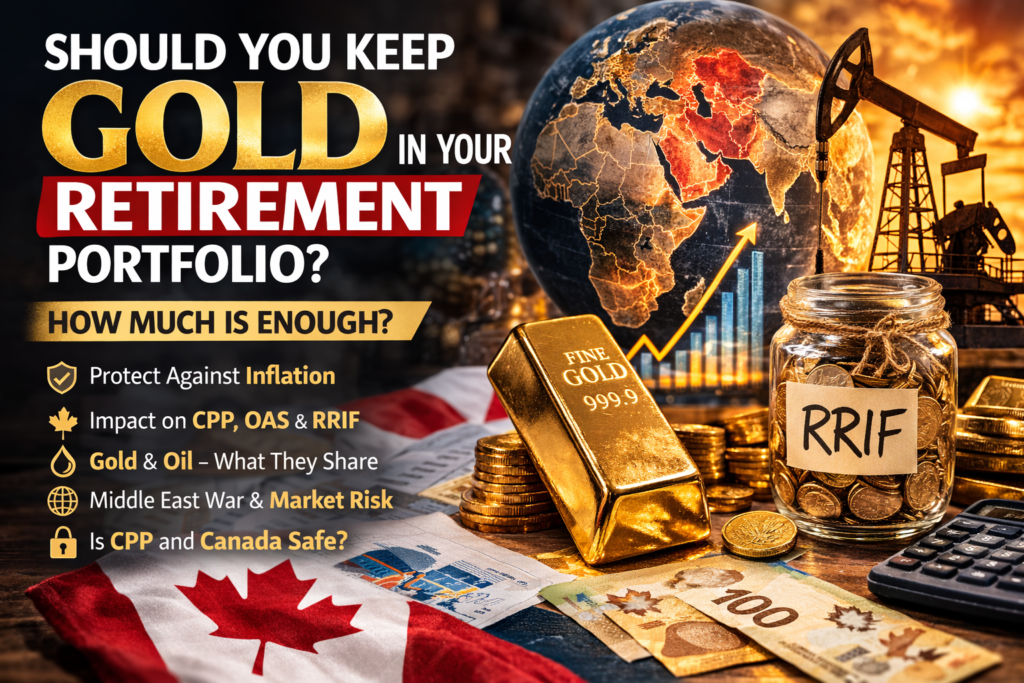
Inflation, global conflict, and market volatility have pushed many retirees to ask a simple question:
Should gold be part of a retirement portfolio?
Gold has been used as a store of wealth for thousands of years. But modern retirement planning requires more than tradition. Investors need to understand what gold actually does in a portfolio, how much to own, and whether it helps protect income from programs like CPP, OAS, and RRIF withdrawals.
Let’s break it down.
Is Gold Really a Hedge Against Inflation?
Gold is often described as an inflation hedge, but the reality is more complicated.
Some research shows gold can protect purchasing power during periods of high inflation, but it is not consistently correlated with inflation over long periods.
In fact:
- Gold performs best during economic crises and uncertainty
- During normal economic periods, it can lag stocks and other investments
- Over very long periods, gold’s real returns have historically been modest compared to equities
This means gold is best viewed as a diversification tool, not a primary growth investment.
How Much Gold Should Be in a Portfolio?
Most financial planners suggest a small allocation, typically:
| Investor Type | Gold Allocation |
| Conservative retirees | 5% |
| Balanced portfolios | 5–10% |
| Aggressive hedgers | up to 15% |
The goal is not to replace stocks or bonds.
Instead, gold acts as portfolio insurance when markets or currencies lose value.
Too much gold can hurt long-term growth because gold does not produce income or dividends.
Gold and Your Retirement Income (CPP, OAS, RRIF)
Gold can indirectly affect retirement income planning.
1. CPP (Canada Pension Plan)
CPP benefits are not affected by your investment portfolio. Your CPP payment depends on your work history and contributions.
The Canada Pension Plan itself is backed by one of the world’s largest pension funds, which held over $700 billion in assets in recent years.
This means CPP is broadly diversified across global assets and is considered financially sustainable.
Gold holdings in your personal portfolio will not change CPP payments.
2. OAS (Old Age Security)
Gold can impact OAS clawback depending on how it’s held.
If gold is sold at a profit:
- Capital gains increase your taxable income
- Higher income can trigger the OAS recovery tax
The OAS clawback begins when income exceeds roughly the mid-$90,000 range.
For retirees with large gold gains, this could reduce OAS benefits.
3. RRIF Withdrawals
Gold inside an RRSP or RRIF behaves like any other investment.
Important points:
- Mandatory RRIF withdrawals are taxed as income
- Gold price gains inside the RRIF are tax-deferred until withdrawn
- Selling gold to fund withdrawals may increase taxable income
This means gold can help with diversification, but it doesn’t eliminate taxes from RRIF withdrawals.
What Gold and Oil Have in Common for Retirement
Gold and oil are often influenced by similar macroeconomic forces.
Both tend to rise when:
- Inflation expectations increase
- Geopolitical tensions escalate
- Currency values decline
Energy shocks—especially oil supply disruptions—can push inflation higher, which often leads investors to buy gold as protection.
However, there is a key difference:
- Oil generates income through dividends (energy stocks)
- Gold does not produce income
That’s why gold works best alongside dividend-producing assets, not instead of them.
Gold and the Middle East Conflict
Recent geopolitical tensions have pushed investors toward safe-haven assets.
Gold prices often rise during wars or geopolitical instability because investors look for assets that are not tied to any government or currency.
For example, during recent Middle East conflicts:
- Energy supply fears pushed oil prices higher
- Investors shifted toward gold and the U.S. dollar as safe havens
Gold’s role here is psychological as much as financial—it represents stability when markets feel uncertain.
Does Canada Have a Gold Stockpile?
Surprisingly, Canada has almost no gold reserves.
Unlike many countries that hold large bullion reserves, Canada sold most of its gold decades ago and now holds its foreign reserves mainly in foreign currencies and government bonds.
Canada’s international reserves total over $100 billion, but gold makes up only a tiny portion of those holdings.
Instead of gold, Canada relies more heavily on financial assets.
Is the CPP Safe?
The Canada Pension Plan is widely considered one of the most sustainable public pension systems in the world.
The CPP Investment Board manages hundreds of billions in assets and invests globally across:
- infrastructure
- real estate
- equities
- private equity
- energy
- technology
Because the fund is diversified and contributions continue to flow into the system, long-term projections suggest the plan remains financially stable.
In short:
CPP stability does not depend on gold.
The Real Role of Gold in Retirement
Gold can serve several useful purposes:
✔ Diversification
✔ Protection during financial crises
✔ Insurance against currency decline
But it also has limitations:
❌ No income
❌ Volatile prices
❌ Not a guaranteed inflation hedge
For most retirees, gold should be a small strategic holding, not the core of a retirement plan.
The Bottom Line
Gold can play a role in a retirement portfolio, but it should be viewed as portfolio insurance rather than a primary investment.
A balanced retirement strategy might include:
- dividend stocks
- bonds
- real estate
- global equities
- a small allocation to gold
This combination helps protect purchasing power while still generating the income retirees need from CPP, OAS, and RRIF withdrawals.
Gold may shine during periods of uncertainty—but long-term retirement security still depends on diversification and disciplined investing.
As always thanks for reading,
Greg
© 2026 www.canadaretirementincome.ca Blog For informational purposes only. Not financial or legal advice