
- RRSP Limits 2026
Contribution Room & Deadlines Explained
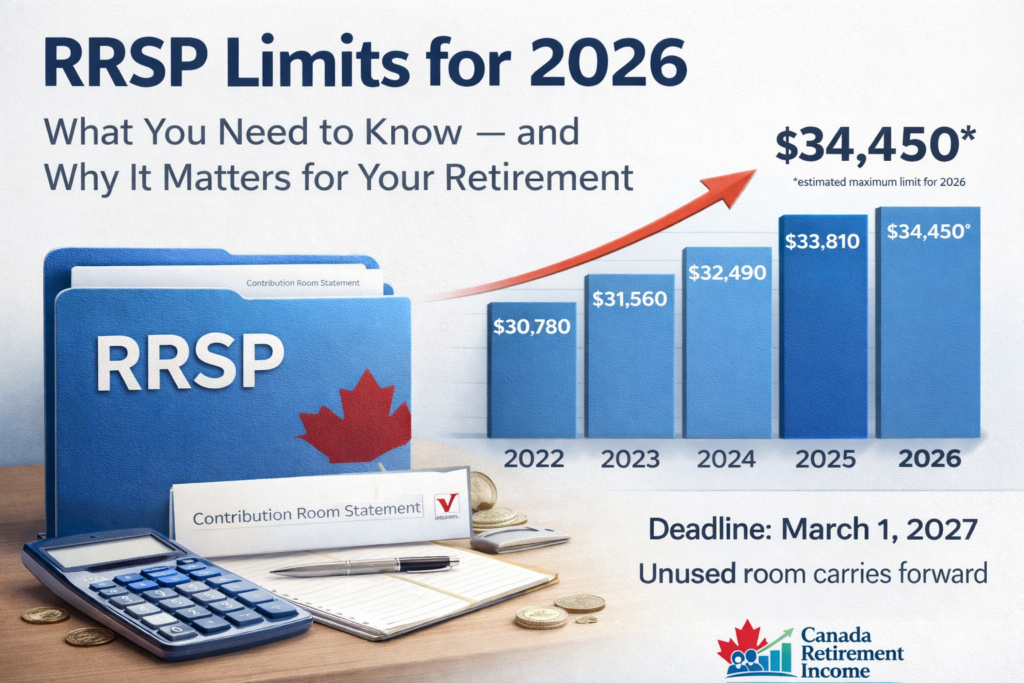
If retirement feels like a distant destination, the 2026 RRSP contribution limit increase is a good reminder that every year you contribute is a year your future self will thank you for. The Canada Revenue Agency has raised the RRSP dollar limit to $33,810 for 2026, up from $32,490 in 2025. That’s an extra $1,320 in tax-sheltered room — and when you’re building a retirement nest egg, that difference adds up faster than you might think.
The 2026 RRSP Contribution Limit: The Numbers
Here’s the quick snapshot for 2026:
| Detail | Amount |
|---|---|
| 2026 RRSP Contribution Limit | $33,810 |
| 2025 RRSP Contribution Limit | $32,490 |
| Calculation method | 18% of prior year earned income, up to the dollar limit |
| Contribution deadline (2025 tax year) | March 2, 2026 |
| Over-contribution buffer (lifetime) | $2,000 |
| TFSA limit for 2026 | $7,000 |
Your personal limit is 18% of your 2025 earned income, up to $33,810. To earn the full $33,810 in new room, you’d need to have earned at least $187,833 in 2025. If your income was lower, your limit is 18% of whatever you earned — but here’s the good news: any unused room from previous years carries forward indefinitely.
Where to find your exact limit: Check your most recent Notice of Assessment from the CRA, or log in to CRA My Account.
Why the RRSP Contribution Limit Is More Than Just a Number
The annual limit increase might seem like a bureaucratic footnote, but it’s actually one of the most powerful levers in your retirement planning toolkit. Here’s why.
1. Tax Deductions Today, Tax-Deferred Growth Tomorrow
Every dollar you contribute to your RRSP reduces your taxable income dollar-for-dollar. If you’re in a 40% marginal tax bracket, contributing $10,000 to your RRSP effectively saves you $4,000 at tax time — money you can reinvest, pay down debt with, or use however you see fit.
The magic really compounds inside the plan. Your investments grow completely sheltered from tax until you withdraw in retirement — ideally at a lower marginal rate than you’re paying now. This tax-deferred compounding is one of the most reliable wealth-building tools available to Canadians.
2. The Power of Starting (or Continuing) Early
Consider this: if you contribute $33,810 per year starting at age 35 and earn an average annual return of 6%, by age 65 you could be looking at well over $2.5 million — much of it built on the power of compounding inside a tax-sheltered account.
Even if you can’t max out the limit, contributing consistently — even $200 or $500 a month — moves you meaningfully closer to retirement security. The worst RRSP strategy is contributing nothing.
3. Unused Room Doesn’t Disappear
Life is unpredictable. Some years, you can’t contribute as much as you’d like. The good news? Unused RRSP room carries forward indefinitely. If you had room you didn’t use in your 30s or 40s, it’s still available to you now. This makes the RRSP especially flexible for Canadians who come into higher income later in their careers — you can catch up in a big way.
Key Deadlines and Rules to Know
The March 2, 2026 Deadline — Contributions made in the first 60 days of 2026 (up to March 2) can still be applied to your 2025 tax return. This is the “first 60 days” rule. If you haven’t yet maxed out your 2025 RRSP room, you still have a narrow window.
Note: March 1 falls on a Sunday this year, so the CRA has extended the deadline to the next business day, March 2, 2026. Don’t wait until the last moment — bank transfers can take 24–48 hours to process.
Age Limit — You can contribute to your own RRSP until December 31 of the year you turn 71. At that point, you must either convert to a Registered Retirement Income Fund (RRIF) or purchase an annuity. Failing to act means the full value of your RRSP will be included as taxable income in that year — a very large, very avoidable tax bill.
Over-Contributing — The CRA allows a lifetime over-contribution buffer of $2,000. Exceeding your limit by more than $2,000 triggers a 1% monthly penalty tax on the excess amount — so track your contributions carefully.
Pension Adjustments — If you’re a member of an employer pension plan (defined benefit or defined contribution), your RRSP limit is reduced by a “pension adjustment” calculated by your employer and reported on your T4. Make sure you factor this in before contributing.
RRSP and Your Broader Retirement Picture
An RRSP doesn’t exist in isolation. For most Canadians, it’s one part of a multi-pillar retirement strategy that includes:
Canada Pension Plan (CPP): The amount you receive in retirement depends on your contributions over your working life and when you begin collecting. You can take CPP as early as 60 or as late as 70 — delaying increases your monthly benefit significantly.
Old Age Security (OAS): A government-funded benefit for Canadians 65 and over. High-income retirees may be subject to the OAS clawback, another reason why managing your income in retirement matters.
TFSA: In 2026, the TFSA limit holds at $7,000, with a cumulative lifetime limit of $109,000 for those eligible since 2009. Unlike an RRSP, TFSA withdrawals are tax-free — making it an excellent complement to your RRSP, particularly in retirement when managing taxable income becomes critical.
Spousal RRSP: Contributing to a spousal RRSP allows the higher-earning spouse to contribute while the lower-earning spouse owns the plan — a powerful income-splitting strategy in retirement when both partners are drawing down funds at (ideally) lower tax rates.
How to Make the Most of the 2026 Increase
A few practical steps to take right now:
- Check your contribution room on CRA My Account or your last Notice of Assessment.
- Set up automatic contributions — even a modest monthly amount builds meaningful wealth over time and prevents year-end scrambling.
- Prioritize your RRSP if you’re a higher-income earner. The tax deduction is more valuable the higher your marginal rate.
- Don’t forget the deadline — March 2, 2026 for your 2025 return.
- Speak with a financial advisor about how your RRSP fits into your broader retirement plan, especially as you approach the conversion age of 71.
The Bottom Line
The 2026 RRSP contribution limit of $33,810 is the highest ever, reflecting both inflation indexing and the CRA’s recognition that Canadians need every advantage they can get to retire comfortably. Whether you’re decades away from retirement or counting down the years, the RRSP remains one of the most effective tools in the Canadian financial landscape.
Contributing now — even a little — is almost always better than waiting. Time in the market, tax-deferred compounding, and the discipline of consistent saving are the real engines of a secure retirement. The limit increase just gives you a little more room to run.
This blog post is for informational purposes only and does not constitute financial or tax advice. Consult a qualified financial advisor or tax professional for guidance specific to your situation.