What CPP, OAS, GIS, RRIF and RRSP Investors Need to Understand
Published March 13, By Greg
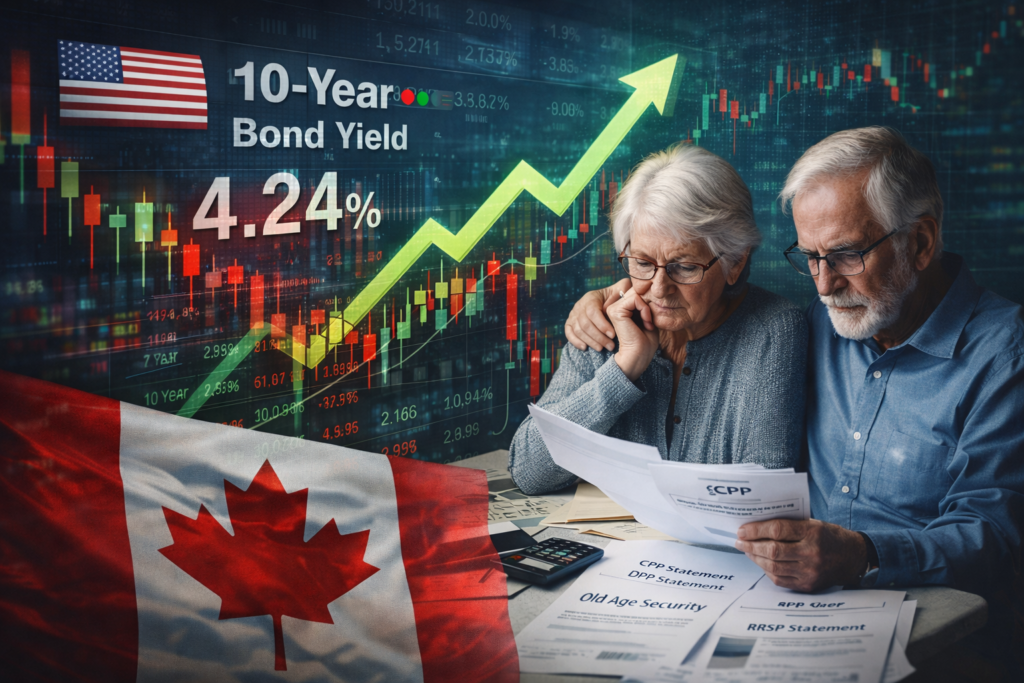
A shift in U.S. bond markets can ripple through mortgages, investments, and retirement income across Canada — often months before headlines explain why.
You’ve spent decades saving. You’ve made smart decisions — maxed your RRSP, planned around CPP and OAS, maybe set up a RRIF. You live in Canada. So why should you care what the U.S. Federal Reserve does with interest rates, or where American bond yields are heading?
The short answer: because the Canadian financial system is deeply connected to U.S. capital markets. What happens to bond yields south of the border ripples north — affecting how much income your retirement accounts generate, when you should buy an annuity, and how the CPP’s investments perform over the long run.
This post breaks it all down in plain language, benefit by benefit.
First: What Are U.S. Bond Yields, Exactly?
A bond yield is simply the return an investor earns on a bond. When the U.S. government (or any government) issues a bond, it promises to pay back the principal plus interest over time. The yield reflects that interest rate — and it moves inversely to price. When bond prices fall, yields rise. When prices rise, yields fall.
The U.S. 10-year Treasury yield is the most watched bond yield on Earth. It’s used as a benchmark for everything from mortgage rates to pension fund return assumptions. When it moves, markets everywhere feel it — including Canada.
Think of U.S. Treasury yields as the “base rate” for global capital. Canadian rates don’t move in lockstep, but they’re heavily influenced — especially at the longer end of the curve.
The Canada–U.S. Rate Relationship
The Bank of Canada sets its own policy rate independently of the U.S. Federal Reserve. But in practice, the two central banks often move in the same direction, because:
• Both economies are deeply integrated through trade (especially post-CUSMA/USMCA).
• Capital flows freely across the border — if Canadian bonds yield significantly less than U.S. bonds, investors sell Canadian bonds to buy American ones, pushing Canadian yields up.
• Inflation and economic cycles in the two countries tend to rhyme, even if the timing differs.
The spread between Canadian Government of Canada (GoC) bond yields and U.S. Treasury yields matters enormously. When U.S. yields spike — as they did dramatically in 2022 and 2023 — Canadian yields followed. That had real consequences for retirees on both sides of every savings product.
CPP: The Pension That Invests Like a Giant Fund
The Canada Pension Plan is managed by CPP Investments, one of the world’s largest pension funds with over $600 billion in assets. Most Canadians think of CPP as a government cheque — but it’s actually a professionally managed investment portfolio.
Related article on CPP and RRIF here
Where Bond Yields Come In
CPP Investments holds a diversified global portfolio that includes bonds, equities, real estate, and infrastructure. The bond portion — and the discount rates used to value long-term liabilities — are directly sensitive to interest rate levels.
• When yields are low (as they were from 2009–2021), pension funds struggle to generate the returns needed to meet future obligations. CPP was forced to take on more risk — more equities, more alternative assets — to compensate.
• When yields rise, bonds become more attractive and liability discount rates increase, which can actually improve a pension fund’s funding status on paper.
For you as a CPP recipient, this doesn’t change your monthly cheque in the short run — CPP’s benefits are defined, not investment-linked. But the long-term sustainability of CPP, and the contribution rates future generations pay, is absolutely tied to how well the fund navigates the interest rate environment.
The good news: CPP has been proactive about diversification and is generally considered one of the best-managed pension funds in the world. But it is not immune to prolonged low-yield environments.
OAS and GIS: Government-Funded, Not Investment-Linked
Old Age Security (OAS) and the Guaranteed Income Supplement (GIS) are funded from general government revenues — not an investment fund like CPP. That means bond yields don’t affect your monthly OAS or GIS payments directly.
Related article on OAS and GIS here
However, there is an indirect connection worth understanding:
• The federal government borrows money by issuing bonds. When U.S. (and Canadian) yields are high, Ottawa pays more to service its debt. Over time, higher borrowing costs create fiscal pressure that can influence government spending decisions — including benefit programs.
• Rising yields also affect the inflation assumptions baked into OAS indexing. OAS is indexed to the Consumer Price Index (CPI), and the interplay between inflation, rate hikes, and fiscal sustainability is complex.
For most retirees collecting OAS and GIS, this is a background concern rather than an immediate one. But if you’re doing long-term planning or advocating for benefit sustainability, understanding the fiscal backdrop matters.
Annuities: The One Retirement Product That Loves High Yields
If you’re considering converting some of your RRSP or RRIF savings into a life annuity, bond yields are probably the single most important factor in your timing decision — and most people don’t realize it.
How Annuity Pricing Works
When you buy a life annuity from an insurance company, you hand over a lump sum in exchange for guaranteed monthly income for life (or a fixed period). The insurance company takes your money, invests it — primarily in long-duration bonds — and pays you out from those returns.
This means annuity payout rates move closely with long bond yields. When the Government of Canada 10-year (or 30-year) yield is high, annuity rates are generous. When yields are low, annuity rates are poor — you get less income per dollar invested.
The 2022–2023 Lesson
The dramatic rise in bond yields from 2022 onward was genuinely good news for people shopping for annuities. After years of record-low rates producing meagre annuity income, rising yields meant you could lock in substantially higher lifetime income. A $300,000 annuity that might have paid $1,200/month in 2020 could pay $1,600/month or more in a higher-yield environment.
Key insight: Annuity rates follow long bond yields with a short lag. If you believe rates have peaked and are heading down, buying an annuity sooner rather than later locks in the current high-rate environment. If you expect rates to rise further, waiting may pay off — but that’s a gamble.
RRIFs: When Rising Yields Are Both a Threat and an Opportunity
Your Registered Retirement Income Fund (RRIF) is subject to mandatory minimum withdrawals each year starting at age 71 (or whenever you convert from an RRSP). The performance of the investments inside your RRIF — including any bonds or bond funds — is directly affected by yield movements.
The Bond Price Trap
Here’s a dynamic that catches many retirees off guard: when interest rates (and yields) rise rapidly, the market value of existing bonds falls. If your RRIF holds bond mutual funds or bond ETFs, you may see significant declines in their NAV — even though “bonds” are supposed to be the safe part of your portfolio.
The longer the bond’s duration, the bigger the price hit from rising yields. A bond fund with a 15-year average duration might drop 15% or more in value when yields rise 1%. Short-term bond funds are far less sensitive.
The Silver Lining
The flip side is that higher yields mean higher ongoing income from new bonds. If you’re reinvesting within your RRIF, or holding individual bonds to maturity, rising yields work in your favour over time. GIC rates — often held inside RRIFs — also tend to rise when bond yields rise, giving you more attractive renewal options.
• Review the duration of any bond funds you hold — shorter duration is more defensive when rates are rising.
• Ladder your fixed income: stagger maturities so you can roll into higher rates as they come due.
• Consider your RRIF withdrawal timing relative to when bond positions mature.
RRSPs: Accumulation Under the Influence of Yields
If you’re still in the accumulation phase — contributing to your RRSP rather than drawing it down — bond yields affect your portfolio differently than they do a RRIF.
The Opportunity in Rising Yields
Rising yields mean falling bond prices — which is painful if you already hold bonds. But for someone still buying bonds or bond funds, rising yields mean you can now purchase income at better rates. Dollar-cost averaging into a bond ETF during a rising rate environment means you’re accumulating yield at progressively better rates.
Asset Allocation Implications
Many RRSP investors use a simple balanced portfolio — 60% equities, 40% bonds, for example. When U.S. Treasury yields spike, it often creates volatility in equities too (higher discount rates compress equity valuations). This can cause painful simultaneous drawdowns in both stocks and bonds — exactly what happened in 2022.
The era of bonds acting as a reliable equity hedge may be less dependable in a higher-inflation, higher-yield environment. Some financial planners are revisiting the role of fixed income in pre-retirement portfolios.
If you’re within 5–10 years of retirement, your RRSP bond exposure deserves a closer look: are you holding long-duration bonds that will take the biggest hits in a continued rising rate environment? Or have you shifted to shorter duration, or even cash/GICs, as you approach the conversion to a RRIF?
Quick Reference: U.S. Yields and Your Retirement Benefits
Here’s how each piece of your retirement picture connects to the bond yield environment:
| Benefit / Account | How U.S. Yields Matter | What to Watch |
| CPP | Invests in bonds; low yields compress returns over time | CPP Investment Board annual report |
| OAS / GIS | Government-funded; indirectly affected via federal borrowing costs | Federal budget balance |
| Annuities | Payout rates move with long bond yields — higher yields = better deals | 10-year GoC and U.S. Treasury spread |
| RRIFs | Bond fund values drop when yields rise; rising yields = income opportunity | Duration of your bond holdings |
| RRSPs | Accumulation phase: rising yields create buying opportunities in bonds | Bond ETF duration and yield-to-maturity |
What Should You Actually Do?
This isn’t a post about timing the market or predicting where the Federal Reserve goes next. Nobody consistently gets that right. Instead, here are practical, yield-aware principles for each stage of retirement planning:
If You’re Still Accumulating (RRSP)
• Don’t abandon bonds because yields rose — use the opportunity to buy income at better rates.
• Check the duration of your bond holdings and consider whether it matches your timeline.
• Use registered accounts efficiently: higher-yielding fixed income is generally best sheltered inside RRSPs/TFSAs.
If You’re Near or In Retirement (RRIF, Annuities)
• Evaluate annuities seriously if yields remain elevated — locking in lifetime income at current rates can make a lot of sense.
• Shorten bond duration inside your RRIF if you’re concerned about further rate volatility.
• GIC ladders are a simple, underused tool: stagger 1-, 2-, 3-, 4-, and 5-year GICs to smooth out rate cycles.
For CPP, OAS, GIS Recipients
• Your monthly cheques aren’t going anywhere because of U.S. bond yields — these programs are resilient by design.
• Focus instead on how your supplemental savings (RRSP, RRIF, TFSA) interact with the rate environment.
• The sustainability of CPP over decades is tied to global capital markets performance — worth monitoring annually.
The Bottom Line
U.S. bond yields aren’t just an abstract number flashing on a Bloomberg terminal. For Canadian retirees, they influence annuity pricing, RRIF portfolio values, CPP investment returns, and the government’s fiscal capacity to sustain OAS and GIS.
You don’t need to become a bond market expert. But understanding the basic relationship — that rising yields can hurt existing bondholders while benefiting new buyers and annuity purchasers — goes a long way toward making smarter decisions at every stage of retirement.
As always, the best moves are the ones that fit your specific situation: your timeline, your risk tolerance, and your income needs. If you’re unsure how your portfolio is positioned relative to the current rate environment, it’s worth a conversation with a fee-only financial planner.
Have questions about how this applies to your own CPP, OAS, or registered savings? Drop a comment below — I read every one.
As always thanks for reading,
-Greg
See related blog posts here
© 2026 www.canadaretirementincome.ca
This article is for informational purposes only and does not constitute financial or tax advice. All figures and scenarios are illustrative. Please consult a qualified financial advisor for guidance specific to your situation.