It’s one of the most emotionally charged financial decisions Canadians face. The math doesn’t always give a clear winner — but your personal situation usually does.
BY Greg- March 01-2026 · 9 MIN READ
For many Canadians in their late 50s and early 60s, there’s a moment when two competing instincts collide. The first says: retire without debt, period. The second says: your money works harder invested than it does paying down a low-rate mortgage. Both instincts have merit. Neither is universally right.
The answer depends on your mortgage rate, your expected investment returns, your tax situation, your risk tolerance, and — perhaps most importantly — how you’d sleep at night carrying a mortgage into retirement. Let’s work through all of it.
The Case for Each Side
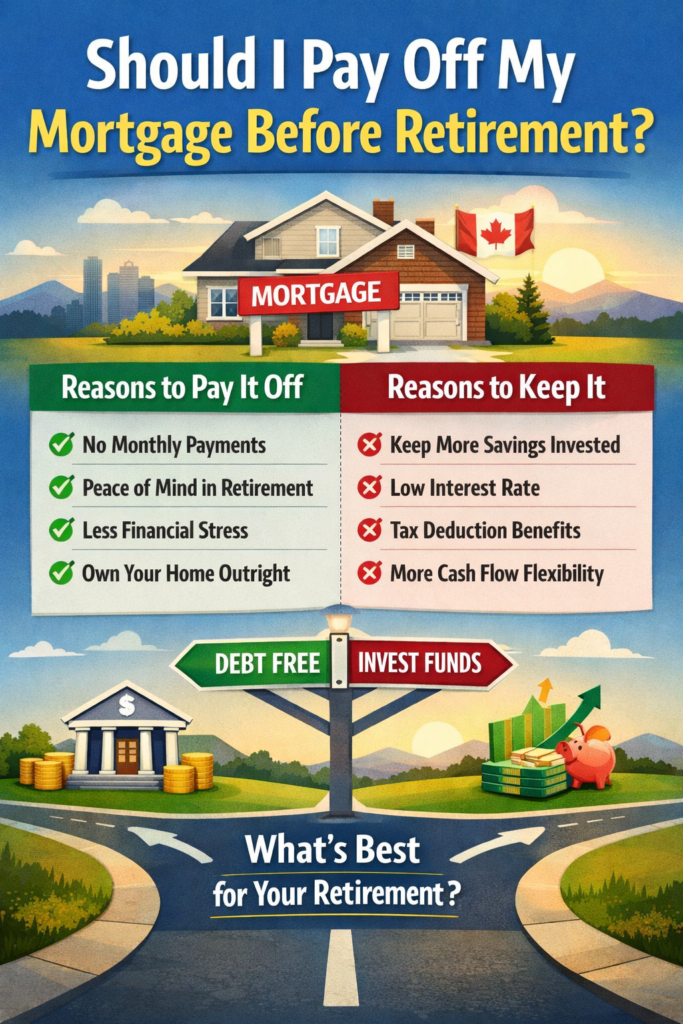
Pay Off the Mortgage
- Guaranteed, risk-free “return” equal to your mortgage rate
- Eliminates a fixed monthly obligation from your retirement budget
- Reduces income needed from savings each month
- Psychological peace of mind — your home is yours outright
- Protects against sequence-of-returns risk in early retirement
- Simplifies retirement income planning considerably
VS
Invest the Difference
- Historically, long-term market returns exceed most mortgage rates
- RRSP contributions reduce taxable income today — a real dollar benefit
- TFSA growth is tax-free and compounding works in your favour
- Liquidity — invested money is accessible; home equity is not
- Mortgage interest is a known, fixed cost; investment upside is open-ended
- Diversification beats having all your wealth in one illiquid asset
The Math: Where It Actually Lands
Let’s put some numbers to it. Suppose you have $2,000 per month in extra cash flow for the next 10 years before retirement. Your mortgage rate is 4.5% and you expect your investments to return 6% annually. Here’s what each path looks like:
Scenario: $2,000/month for 10 years — Pay Down vs. Invest
OPTION A
Accelerate Mortgage Payments
Extra monthly payment$2,000
Mortgage rate4.5%
Guaranteed annual “return”4.5%
Interest saved over 10 yrs~$58,000
Monthly budget freed at retirement~$2,400
Mortgage-free at retirement?Yes ✓
OPTION B
Invest the $2,000 Instead
Monthly investment$2,000
Expected annual return6.0%
Portfolio value after 10 yrs~$328,000
Mortgage still outstanding~$140,000
Net advantage over Option A~$130,000
On paper winner?Yes — but…
On paper, investing wins — assuming the 6% return materializes. But that assumption carries real risk. Markets don’t deliver smooth 6% returns every year. A sharp downturn in the first few years of retirement, combined with a mortgage payment you still owe, can force you to sell investments at a loss to cover the shortfall. This is called sequence-of-returns risk, and it’s one of the most dangerous forces in early retirement.
Paying off the mortgage is a guaranteed 4.5% return. The stock market’s 6% is historical average — not a promise.
“A paid-off home doesn’t just save you money. It reduces how much income you need every month — which means your savings don’t have to work as hard, for as long.”
The Tax Angle Changes Everything
Here’s where many Canadians miss a critical piece. If you have remaining RRSP contribution room, the calculus shifts meaningfully. Every dollar you put into your RRSP instead of your mortgage earns you a tax refund — typically worth 30–43% of the contribution depending on your province and income. That tax refund can then be used to make an extra mortgage payment.
In effect, you’re doing both — investing in your RRSP at a tax-subsidized rate, then using the refund to pay down debt. This hybrid approach is one of the most efficient strategies available to higher-income Canadians in the final pre-retirement stretch.
Your TFSA is also worth considering here. Unlike RRSP withdrawals, TFSA withdrawals don’t count as income in retirement. If you invest extra money in your TFSA now instead of paying down the mortgage, you build a pool of tax-free funds you can draw on to cover that mortgage payment in retirement without affecting your OAS eligibility or pushing you into a higher tax bracket.
When Paying Off the Mortgage Wins
🏠
Your mortgage rate is high
If you’re renewing into a 5–6%+ mortgage, paying it down is a near-guaranteed return that’s very hard to beat after tax. The higher the rate, the stronger the case for elimination.
😰
Debt in retirement causes you real stress
Financial decisions aren’t purely mathematical. If the thought of carrying a mortgage into retirement keeps you up at night, the psychological value of eliminating it is real and worth paying for.
📉
You have a low risk tolerance
If a market downturn early in retirement would cause you to sell investments in a panic, a paid-off home lowers your monthly income needs — reducing the amount you need to draw from a potentially depressed portfolio.
💼
You have a generous pension
If your DB pension, CPP, and OAS already cover most of your retirement income needs, you may have less urgent need for a large investment portfolio. Paying off the mortgage simplifies everything.
When Investing the Difference Wins
📊
Your mortgage rate is low and your RRSP room is large
If you’re carrying a 3% mortgage and have significant unused RRSP room, the tax deduction alone may make investing the smarter move. The after-tax cost of the mortgage is very low.
🕐
You’re more than 10 years from retirement
Time in the market is a powerful force. The longer your investment horizon, the more reliably long-term averages smooth out short-term volatility — making the invest-the-difference strategy more defensible.
💧
You have limited liquid savings
Home equity is illiquid. If an emergency arises in retirement and your wealth is locked in your home, you’ll need to take out a HELOC or sell — both of which come with costs and complications. A healthy investment portfolio gives you accessible cash.
The Middle Ground: Strategies That Do Both
- The RRSP Refund AcceleratorMaximize your RRSP contribution, claim the tax refund, and apply every dollar of the refund directly to your mortgage principal. You grow your retirement savings and shrink your debt simultaneously — using the government’s money to do part of the work.
- Split the Extra Cash FlowIf you have $2,000 per month in extra room, direct $1,000 toward mortgage prepayment and $1,000 into your TFSA. You reduce debt risk and build a liquid, tax-free reserve at the same time. Less optimal on paper — better for most people in practice.
- Target Mortgage-Free at Retirement, Not BeforeRather than aggressively paying down the mortgage today at the cost of your investment portfolio, structure your amortization so your final payment coincides with your planned retirement date. This preserves cash flow for investing in the years leading up to retirement while ensuring you arrive debt-free.
- Use a HELOC as a Safety NetSome Canadians invest aggressively while keeping a Home Equity Line of Credit available as an emergency buffer. The HELOC stays at zero unless needed — but it provides liquidity without forcing investment liquidation in a downturn. This isn’t for everyone, but it addresses the illiquidity concern that often drives people toward paying off the mortgage first.
The Real Answer
If your mortgage rate is above 5%, paying it off before retirement is almost always the right move. The guaranteed, risk-free return is simply too hard to beat consistently after tax.
If your rate is below 4% and you have significant RRSP or TFSA room, the math favours investing — especially if you have a long horizon and strong risk tolerance.
If you’re somewhere in between — which most Canadians are — the hybrid approach is likely best: invest in your registered accounts for the tax advantages, use refunds and bonuses to make lump-sum mortgage payments, and aim to arrive at retirement either mortgage-free or very close to it.
Above all: don’t sacrifice your investment portfolio entirely to pay off a low-rate mortgage. Liquidity and diversification matter in retirement. A paid-off home with no savings is a fragile position — beautiful on paper, brittle in practice.
The Bottom Line
There is no single right answer to whether you should pay off your mortgage before retirement. There is a right answer for you — based on your rate, your savings, your income, your risk tolerance, and your vision for what retirement actually looks like.
What’s certain is this: arriving at retirement with no fixed debt obligations, a meaningful investment portfolio, and a clear income plan gives you the most flexibility of all. The goal isn’t to win the math debate. It’s to retire with options.
This article is for informational purposes only and does not constitute financial or tax advice. All figures and scenarios are illustrative. Please consult a qualified financial advisor or mortgage professional for guidance specific to your situation.
THE RATE DECISION AT A GLANCE
Pay off (5%+)
Strong
Toss up (4–5%)
50/50
Invest (<4%)
Favours
Assumes 6% long-run investment return and available registered account room. Individual tax situation will shift this.
KEY QUESTIONS TO ASK YOURSELF
What is my current mortgage rate?Compare it honestly to your after-tax expected investment return.
Do I have RRSP or TFSA room?Registered account tax advantages change the equation significantly.
How much liquid savings do I have?Don’t sacrifice liquidity entirely to pay down an illiquid asset.
How do I feel about debt in retirement?Psychological comfort is a real financial factor worth pricing in.
When does my mortgage renew?Renewal is a natural decision point to reassess the strategy.
As always thanks for reading ,
Greg
© 2026 www.canadaretirementincome.ca – For informational purposes only · Not financial advice